Pilgrimage · 9 min read
What the Camino de Santiago Teaches About Returning to God
The Camino is more than a long walk. It is a visible image of the spiritual life: one step, one burden, one prayer, one return to God.
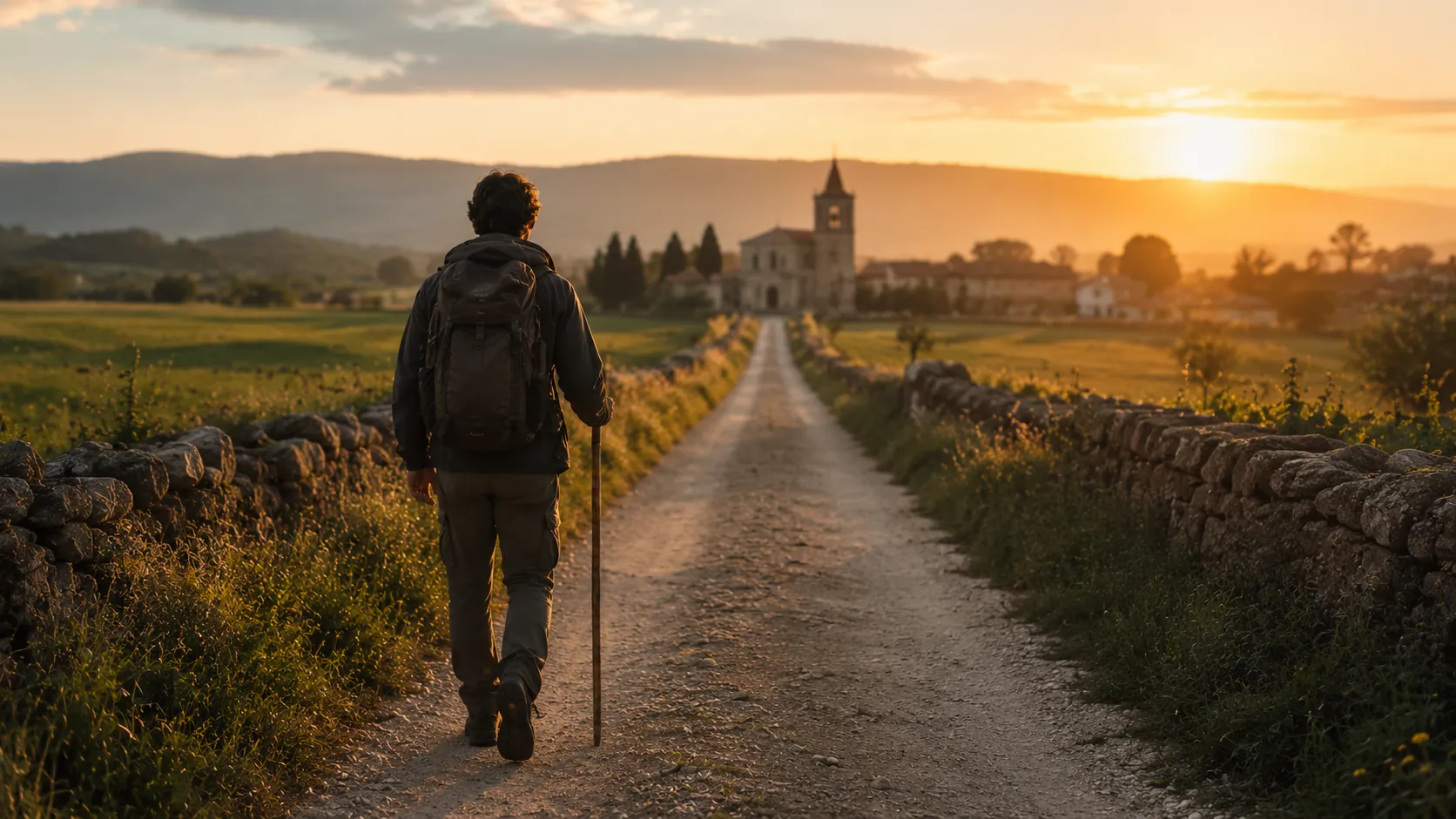
There is something powerful about a road. A road tells you that you are not meant to remain exactly where you are. It invites movement, effort, patience, and trust. The Camino de Santiago has drawn pilgrims for centuries because it makes the spiritual life visible: one step after another, with a destination beyond yourself.
Many people hear about the Camino and imagine an adventure, a challenge, a long walk across Spain, or a beautiful travel story. It can be all of that. But at its heart, pilgrimage is not tourism. It is a journey of the soul.
The Catholic meaning of the Camino de Santiago is not only found at the end of the road. It is found in the daily walking, the tired feet, the silence, the strangers, the churches, the questions, the prayers, and the gradual discovery that God often works while we are simply taking the next step.
What Is the Camino de Santiago?
The Camino de Santiago is a network of pilgrimage routes that lead to Santiago de Compostela in Spain, traditionally associated with the tomb of St. James the Apostle. Pilgrims have walked these roads for centuries, carrying prayers, penance, gratitude, grief, questions, and hope.
Today, people walk the Camino for many reasons. Some are deeply religious. Some are searching. Some are grieving. Some want simplicity. Some want to test themselves. Some do not know exactly why they are walking until the road begins to reveal it.
That is part of the mystery of pilgrimage. You may begin with one reason and discover another. You may think you are walking toward a place and realize, slowly, that you are being invited back to God.
Pilgrimage Is Not Tourism
Tourism often asks, “What can I see?” Pilgrimage asks, “What must change in me?” Tourism collects experiences. Pilgrimage receives a journey. Tourism can remain on the surface. Pilgrimage asks the heart to become honest.
This does not mean pilgrimage cannot include beauty, food, landscapes, friendship, or joy. It should. Creation is a gift. Human company is a gift. But the deeper purpose is not consumption. The deeper purpose is conversion.
A pilgrim walks differently because the destination matters. Santiago is not only a city on a map. It becomes a sign of heaven, of home, of the saints, of the Church, and of the long road back to the Father.
The Road Reveals What You Carry
One of the first lessons of the Camino is physical: you cannot carry everything. A heavy backpack becomes a teacher. Too many things slow you down. Unnecessary weight becomes painful.
The same is true in the soul. We carry old resentments, fears, distractions, pride, guilt, unfinished grief, and false images of ourselves. Pilgrimage gives those hidden burdens time to surface.
The road does not magically heal everything. But it creates space. It removes some noise. It teaches the pilgrim to ask: what am I carrying that God never asked me to carry?
How Walking Can Become Prayer
Prayer does not only happen when the body is still. The body can also pray through movement. Walking can become a rhythm of surrender: step, breath, prayer, silence, return.
A pilgrim may pray the Rosary while walking. Another may repeat a short phrase: “Lord, guide me.” Another may walk in silence and offer the fatigue. Another may stop in small churches along the way and sit before God without many words.
Praying while walking is not complicated. It begins by turning the journey toward the Lord. The road becomes more than distance. It becomes attention.
A Simple Walking Prayer
Lord,
walk with me today.
Guide my steps.
Lighten what I carry.
Teach me to notice Your presence on the road.
When I grow tired, give me patience.
When I lose direction, bring me back.
Let every step become a small return to You.
Amen.
The Camino Teaches Simplicity
Modern life trains us to want more: more information, more options, more comfort, more control, more noise. Pilgrimage strips some of that away. You wake, walk, eat, rest, pray, and begin again.
Simplicity can feel uncomfortable at first. Without constant distraction, the heart has nowhere to hide. But simplicity also brings freedom. You begin to notice the sky, the kindness of strangers, a shared meal, a church bell, a quiet path, a small act of help.
The spiritual life needs this kind of simplicity. Not because ordinary responsibilities are bad, but because the soul can become buried under too much noise. Pilgrimage reminds us that less can make room for God.
The Camino Teaches Effort Without Control
A pilgrim must walk, but cannot control everything. Weather changes. Feet hurt. Plans fail. A bed may be unavailable. The body may be weaker than expected. The road asks for effort, but also surrender.
This is close to the Christian life. We cooperate with grace. We make choices. We pray, repent, forgive, serve, and begin again. But we do not control the timing of every consolation, answer, healing, or spiritual fruit.
The Camino teaches a hard mercy: you are responsible for the next step, not the whole road at once.
One Step Is Enough for Today
When life feels heavy, we often want certainty about the entire future. God usually gives grace for the next faithful step. That step may be a prayer, an apology, a confession, a Sunday Mass, a difficult conversation, a small act of mercy, or a decision to stop running.
Pilgrimage trains this trust. You do not arrive in Santiago on the first day. You walk the path that is given today.
St. James and the Call to Follow Christ
The Camino leads to the city associated with St. James, one of the apostles called by Jesus. James left his nets and followed the Lord. Like every apostle, his story begins with a call.
Pilgrimage reminds us that faith is not only admiration from a distance. Christ calls people to follow. Sometimes that following is dramatic. More often, it is daily: leaving behind one attachment, one sin, one fear, one excuse, and taking one step toward Him.
To walk toward Santiago is to remember that the saints were not statues first. They were people who heard a call and moved.
What If You Cannot Walk the Camino?
Not everyone can travel to Spain. Not everyone can take weeks away from work or family. Not everyone has the money, health, or freedom to walk a long pilgrimage route. That does not mean pilgrimage is closed to you.
The spirit of pilgrimage can enter ordinary life. You can walk to a nearby church. You can visit a local shrine. You can make a short prayer walk in your neighborhood. You can choose one Saturday morning to walk in silence with an intention.
A pilgrimage is not defined only by distance. It is defined by intention. You set out toward God with your body, your time, and your heart.
A Small Pilgrimage Close to Home
- Choose a nearby church, chapel, shrine, cemetery, or quiet place of prayer.
- Walk there if possible, or travel simply and intentionally.
- Begin with one clear intention.
- Keep part of the journey silent.
- Offer any discomfort instead of complaining.
- When you arrive, pray for one minute.
- Give thanks before returning home.
This may not look impressive. That is all right. The hidden journey can still be real.
Pilgrimage and Confession
Pilgrimage often brings truth to the surface. When the noise fades, the conscience may become clearer. Old sins, neglected duties, broken relationships, or spiritual laziness may become harder to ignore.
This is not meant to crush you. It is an invitation to mercy. A good pilgrimage leads not only to beautiful views, but to conversion. If the road reveals a need for Confession, receive that as grace.
The Sacrament of Reconciliation is one of the clearest ways to stop carrying what Christ wants to forgive.
Pilgrimage and the Mass
For a pilgrim, Mass is not an interruption to the journey. It is the heart of the journey. The road leads the body forward, but the Eucharist feeds the soul.
If you make any kind of pilgrimage, even a small one, consider including Mass if possible. Bring your intention to the altar. Let the journey become worship, not only reflection.
The Christian road always leads back to Christ present among His people.
Spiritual Lessons From the Camino
- You cannot carry everything.
- The next step matters more than perfect certainty.
- Silence reveals what noise hides.
- Strangers can become signs of grace.
- The body matters in prayer.
- Discomfort can become offering.
- The destination gives meaning to the road.
- Returning to God usually happens one step at a time.
These lessons are not only for Spain. They belong to ordinary life. Every day gives you roads: the commute, the school run, the hospital corridor, the walk to work, the path to church, the quiet return after failure.
One Small Action You Can Take Today
- Take a ten-minute walk without headphones.
- Carry one intention in your heart.
- Repeat slowly: Lord, guide my steps.
- Offer one burden to God as you walk.
- End by making the Sign of the Cross.
That small walk will not be the Camino de Santiago. But it can be a beginning. It can teach your body and soul to move toward God again.
What the Camino Teaches About Returning to God
The Camino is powerful because it gives form to something every soul needs: the road back to God. We wander, carry too much, lose focus, grow tired, meet help, resist grace, receive mercy, and keep walking.
You may never walk to Santiago. But you can still become a pilgrim. Begin with one step. One prayer. One return. One act of trust.
God is not only waiting at the destination. He is walking with you on the road.
Before you go… Take one quiet minute. Speak honestly to God. One sentence is enough. He is already listening.
Begin every morning with one quiet minute. Receive a short prayer, a reflection, a Saint, and one simple action—delivered to your inbox each morning. Join the One Minute Catholic community today.
Questions
What is the Catholic meaning of the Camino de Santiago?
The Camino is a pilgrimage route traditionally associated with St. James. Its deeper meaning is spiritual: walking toward God with prayer, effort, simplicity, repentance, and trust.
Can I make a pilgrimage if I cannot travel far?
Yes. You can make a small pilgrimage to a nearby church, shrine, cemetery, or quiet place of prayer. Intention matters more than distance.
How can I pray while walking?
Choose a short phrase such as “Lord, guide my steps,” repeat it gently, carry one intention, and offer the walk to God.
What does the Camino teach about faith?
It teaches simplicity, perseverance, humility, dependence on grace, and the importance of taking the next faithful step.
Who is St. James in the Camino de Santiago?
St. James was one of the apostles of Jesus. Santiago de Compostela is traditionally associated with his tomb and has been a major pilgrimage destination for centuries.