Adoration · 9 min read
What Is Eucharistic Adoration and How Do You Begin?
Eucharistic Adoration is not complicated. It begins with being present before Jesus, even for one quiet minute.
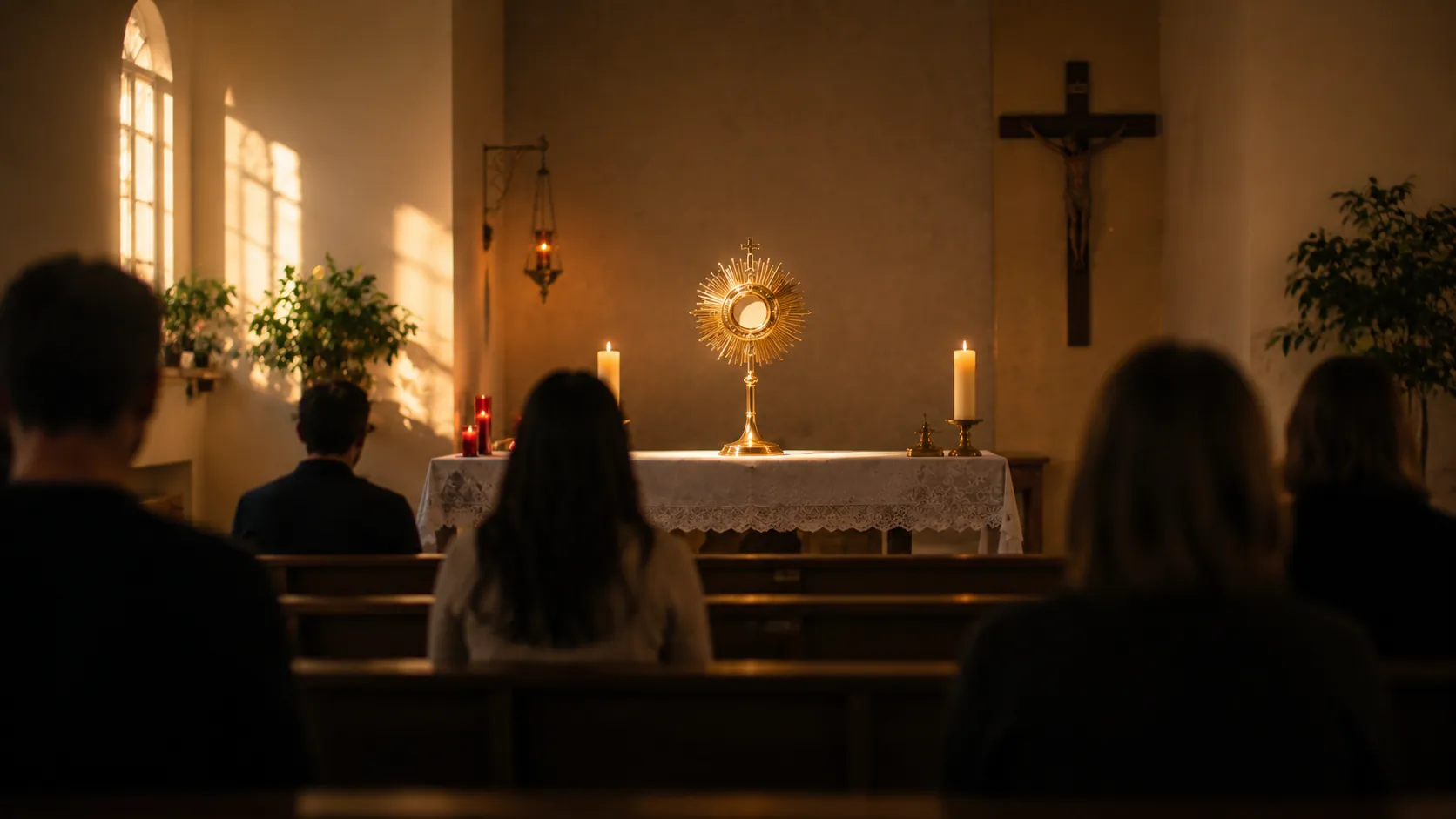
You have heard people mention Adoration. Maybe your parish has a chapel. Maybe you saw a notice for a Holy Hour. Maybe someone told you that sitting before the Blessed Sacrament changed their prayer life. But you are not sure what actually happens there. If Eucharistic Adoration feels beautiful but intimidating, stay here for one minute.
Many people avoid Adoration not because they reject it, but because they do not know what to do. They imagine everyone else knows the rules. They worry they will sit awkwardly, run out of words, or feel nothing. They wonder how long they are supposed to stay and whether beginners are welcome.
The simple answer is this: Eucharistic Adoration is time spent in prayer before Jesus truly present in the Blessed Sacrament. You do not need to be advanced in prayer. You do not need perfect focus. You do not need an hour of beautiful thoughts. You can begin with presence.
What Is Eucharistic Adoration?
Eucharistic Adoration is a form of prayer in which the faithful worship Jesus Christ present in the Eucharist. The consecrated Host is usually placed in a vessel called a monstrance, so people can pray before the Blessed Sacrament.
This is not symbolic in the shallow sense. The Church teaches that Christ is truly present in the Eucharist: Body, Blood, Soul, and Divinity. In Adoration, you are not sitting before an idea about Jesus. You are remaining before the Lord Himself.
That may sound overwhelming. But it should also be consoling. Adoration is not about impressing God. It is about being with the One who already sees you and loves you.
Adoration Is Presence Before Presence
A helpful way to understand Adoration is this: you bring your presence before His Presence. You come with your tired mind, restless thoughts, questions, gratitude, guilt, hope, or silence. You place yourself before Jesus and let Him look at you with mercy.
You may feel peaceful. You may feel distracted. You may feel bored. You may feel deeply moved. None of these feelings are the foundation. The foundation is that He is there, and you are there with Him.
Can Beginners Go to Adoration?
Yes. Beginners can go to Adoration. People returning to prayer can go. People who have not prayed in years can go. People who do not know what to say can go. You do not need to earn your seat in the chapel.
If it is your first time, do not put pressure on yourself. You can stay five minutes. You can sit near the back. You can be quiet. You can pray one simple sentence. Nobody needs you to perform holiness.
The spiritual life often grows through small, repeated returns. One short visit to Adoration may become a habit. A habit may become a deeper friendship with the Lord.
What Happens During Eucharistic Adoration?
The exact setting can vary. In some churches, Adoration happens in the main church. In others, there is a smaller chapel. Sometimes there is silence. Sometimes there are hymns, Scripture, Benediction, or a scheduled Holy Hour.
Usually, people enter quietly, kneel or sit, and pray. The Blessed Sacrament may be exposed in a monstrance on the altar. People may read, pray the Rosary, journal, sit silently, or simply look toward the Eucharist.
If you are unsure what to do physically, follow the reverent pattern around you. Genuflect or kneel if you are able. Sit quietly. Keep your phone silent. Let the space teach you.
You Do Not Have to Fill the Time
One of the biggest mistakes beginners make is thinking they must fill every minute. They arrive with a list of prayers, readings, thoughts, and intentions, then feel anxious when their attention runs out.
Adoration is not a meeting you have to manage. It is not spiritual productivity. It is time with Jesus. Some words are good. Silence is also good. Looking at Him and letting Him look at you can be prayer.
What to Do During Eucharistic Adoration
If you do not know where to begin, use a simple structure: arrive, adore, speak, listen, entrust, and thank. This gives your mind a path without turning prayer into a performance.
- Arrive quietly and make the Sign of the Cross.
- Adore Jesus present in the Blessed Sacrament.
- Speak honestly about what you are carrying.
- Listen in silence without forcing anything.
- Entrust one worry, person, or decision to Him.
- Thank Him before you leave.
This structure can take five minutes or an hour. The length matters less than the honesty of your presence.
Simple Things to Say in Adoration
If words do not come easily, begin with short prayers. You can repeat one slowly and let it become your anchor.
- Jesus, I believe You are here.
- Lord, I am here with You.
- Jesus, teach me to adore You.
- I give You what I cannot carry.
- Stay with me, Lord.
- Help me receive Your peace.
- I trust You with this person.
- Thank You for waiting for me.
How Long Should You Stay in Adoration?
If you are a beginner, start small. Five minutes is enough to begin. Ten minutes is good. One minute can be real if it is honest. You do not need to begin with a full Holy Hour.
Many people fail because they start with too much. They decide they will go for an hour every week, then miss once and quit. A smaller faithful habit is better than a heroic plan that collapses immediately.
If your parish has regular Adoration, choose a realistic time. Stop in after work. Visit before picking up your child. Go for ten minutes before errands. Let the practice fit real life first. Depth can grow later.
What If You Feel Nothing?
You may feel nothing in Adoration. That does not mean nothing happened. Feelings are not the measure of Christ’s presence. The Eucharist does not become less real because your emotions are quiet.
Sometimes the deepest prayer feels ordinary. You sit. You are distracted. You return. You offer one concern. You leave. Later, you notice a little more patience, a little more honesty, or a little more desire to pray again.
Do not chase big feelings. Receive them gratefully if they come, but do not demand them. Adoration teaches love that is deeper than mood.
Silent Prayer Before the Eucharist
Silence is one of the great gifts of Adoration. The world is loud. The chapel can become a place where your soul stops running. But silence may feel awkward at first.
Begin with a short prayer, then stop speaking. Look toward the Blessed Sacrament. When thoughts come, gently say, “Jesus, I am here.” Return as many times as needed.
The point of silent prayer is not to erase every thought. It is to remain with the Lord beneath the thoughts.
A One-Minute Adoration Method
- Look toward the Blessed Sacrament.
- Say: Jesus, I believe You are here.
- Sit silently for a few breaths.
- Offer one person or worry to Him.
- Say: Jesus, stay with me today.
- Leave quietly and carry that peace into one small action.
Can You Read, Journal, or Pray the Rosary?
Yes. Many people bring Scripture, spiritual reading, a Rosary, or a journal. These can help you focus and speak honestly. But remember: the center is Jesus present in the Eucharist, not the activity itself.
If reading helps you pray, read slowly. If journaling helps you speak truthfully, write a few lines. If the Rosary helps you stay near Jesus with Mary, pray it gently. If silence draws you, be silent.
Do not compare your prayer to the person beside you. Someone else may kneel for an hour in stillness. You may need to read one Psalm and sit for five minutes. Begin where you are.
A Prayer for Your First Time in Adoration
Pray this slowly when you arrive.
Lord Jesus,
I believe You are here.
I do not know how to adore You well.
But I have come to be with You.
Receive this small visit.
Quiet what is restless in me.
Teach me to listen.
Help me trust Your presence more than my feelings.
Stay with me when I leave this place.
Amen.
Adoration Should Lead Back to Ordinary Life
True Adoration does not end at the chapel door. Time before the Eucharist should slowly change how we live. The peace received there should become patience, mercy, courage, honesty, and charity.
If you spend time before Jesus and then return home a little more gentle, that matters. If you leave with the courage to apologize, serve, forgive, or keep going, Adoration is bearing fruit.
The Eucharist is not an escape from the world. Christ draws us close so He can send us back into ordinary life with His love.
One Small Action You Can Take Today
- Search your parish website for Adoration times.
- Choose one realistic day to visit.
- Start with five minutes.
- Pray: Jesus, I believe You are here.
- Do not judge the visit by how much you feel.
Begin Adoration With Presence
If you are new to Eucharistic Adoration, begin simply. Come into the chapel. Be quiet. Look toward the Blessed Sacrament. Tell Jesus the truth. Sit for a few minutes. Leave with gratitude.
You do not need to be a spiritual expert. You do not need perfect words. You do not need to stay long. The Lord is present, and He receives small beginnings.
Adoration begins with presence before Presence. That is enough for the first step.
Before you go… Take one quiet minute. Speak honestly to God. One sentence is enough. He is already listening.
Begin every morning with one quiet minute. Receive a short daily prayer, a reflection, a Saint, and one simple action—delivered to your inbox each morning. Join the One Minute Catholic community today.
Questions
What is Eucharistic Adoration?
Eucharistic Adoration is prayer before Jesus truly present in the Blessed Sacrament, often exposed in a monstrance on the altar.
Can beginners go to Eucharistic Adoration?
Yes. Beginners are welcome. You can stay for five minutes, pray simply, sit quietly, and begin without pressure.
What should I do during Eucharistic Adoration?
You can pray, sit silently, read Scripture, pray the Rosary, journal, or simply look toward the Blessed Sacrament and speak honestly to Jesus.
How long should I stay in Adoration?
Start small. Five or ten minutes is a good beginning. A faithful short visit is better than an unrealistic plan you cannot keep.
What if I feel nothing in Adoration?
That is normal. Feelings are not the measure of Christ’s presence. Stay gently, offer the moment, and trust that grace can work quietly.