Prayer · 9 min read
A Catholic Prayer for Fear and Anxiety When You Need Courage
When fear feels close and anxiety grows heavy, this Catholic prayer can help you ask God for courage, peace, and one faithful next step.
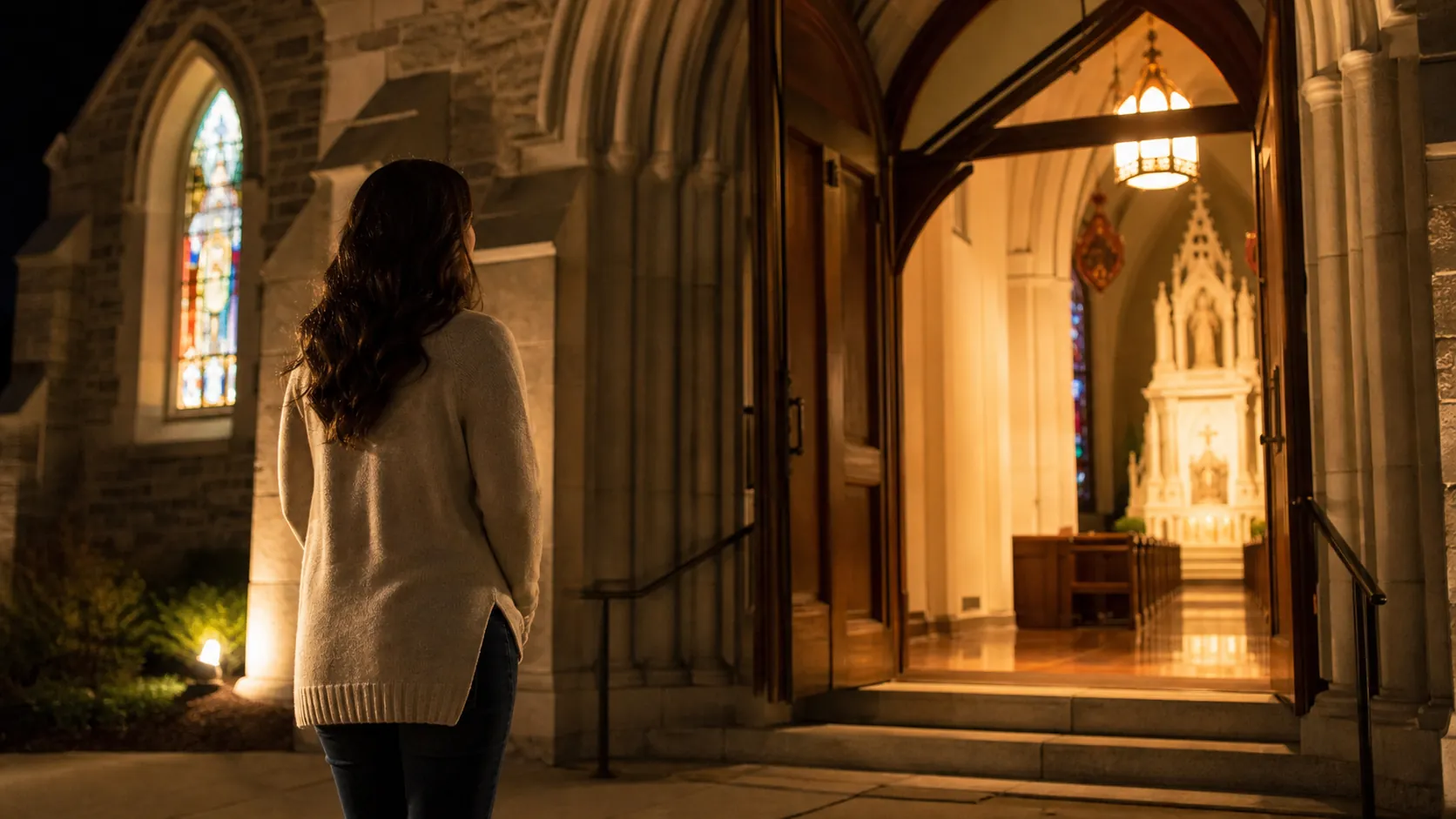
Fear can make the world feel small. A hallway feels longer. A phone call feels heavier. A diagnosis, conflict, decision, memory, or unknown outcome can stand in front of you like a closed door. You may still believe in God, but your body feels weak and your thoughts keep asking whether you will have enough courage. If that is where you are today, stay here for one minute.
A Catholic prayer for fear and anxiety is not about pretending nothing is wrong. It is a way to bring a frightening moment into the presence of Christ. Fear says, “You are alone with this.” Prayer answers, “The Lord is here, and I can take the next step with Him.”
Fear is related to anxiety, stress, and worry, but it has its own shape. Stress is often pressure and overload. Worry often lives in tomorrow and tries to control outcomes. Fear is more immediate. It rises when something feels threatening, unsafe, painful, or too large for your strength.
If your mind will not quiet down and anxiety has become the wider struggle, this Catholic prayer for anxiety may help you pray through that deeper interior weight.
If your fear is tied to overload, deadlines, or too many responsibilities pressing at once, this Catholic prayer for stress focuses on bringing pressure and exhaustion to Christ.
If your fear keeps pulling you into tomorrow through repeated “what if” thoughts, this Catholic prayer for worry may be a better fit for praying through future-facing fears.
But if fear feels close right now, and you need courage for what is in front of you, begin here. God does not ask you to feel brave before you come to Him. He invites you to come while your hands are still shaking.
When Fear Feels Close
Fear can be loud even when nothing outside looks dramatic. You may be afraid before a medical appointment, a difficult conversation, a financial decision, a night alone, a family crisis, or a responsibility you cannot avoid. Other people may not see the weight, but you feel it in your chest, stomach, shoulders, and attention.
The first mercy is to stop shaming yourself for being afraid. Fear is not automatically a failure of faith. It is a human response to perceived danger, weakness, or uncertainty. The question is not whether fear appears. The question is where you bring it.
The spiritual danger is not that fear exists. The danger is letting fear become the voice you obey without question. Fear can make you hide, lash out, avoid duty, or imagine that God has stepped away. Prayer interrupts that false authority.
Fear Needs Presence, Not Performance
When you are afraid, you may not be able to form beautiful words. That is all right. You do not need to perform holiness for God. You can simply say, “Jesus, I am afraid.” That sentence is not weak. It is honest, and honest prayer can become a doorway to grace.
A frightened child does not need a lecture first. A frightened child needs a hand. The Father knows this. He is not embarrassed by your need for reassurance. He can receive the part of you that feels small.
What Scripture Says When You Are Afraid
Scripture does not pretend that God's people never feel afraid. Again and again, the Lord speaks into fear with the words, “Do not be afraid.” Those words are not a scolding. They are a promise of presence.
When the angel Gabriel comes to Mary, he says, “Do not be afraid.” Mary is not given every detail of the future. She is given a call and grace. Her fiat is not naive confidence. It is trust offered while the future remains hidden.
Jesus also speaks peace to frightened hearts. After the Resurrection, He comes to the disciples who are locked behind doors and says, “Peace be with you.” He does not wait outside until they become brave. He enters the locked place.
That image matters when fear and anxiety feel heavy. Christ can enter the room of the heart that has closed itself for protection. He can stand in the place where you feel trapped and give peace that is stronger than circumstances.
A Short Catholic Prayer for Fear and Anxiety
Pray this slowly when fear feels near. Let the words become a small act of trust.
Lord Jesus,
I am afraid right now.
My heart feels unsteady,
and anxiety is heavy in me.
Come close to this frightened place.
Remind me that I am not alone.
Give me courage for what is in front of me,
peace for the thoughts I cannot calm,
and trust in the Father’s care.
Hold me near Your Sacred Heart.
Mary, pray with me and lead me to your Son.
Help me take one faithful step.
Amen.
How to Pray When Fear Takes Over
When fear takes over, begin with the body. Make the Sign of the Cross slowly. Put your feet on the floor. Let your hands open instead of clenching. You are not trying to control your body by force. You are letting your body remember that it belongs to God.
Then name the fear plainly. Do not exaggerate it, and do not hide it. Say, “Lord, I am afraid of this conversation.” Say, “Jesus, I am afraid of bad news.” Say, “Father, I feel unsafe inside myself right now. Stay with me.”
After naming the fear, ask for courage for the next step. Not courage for the whole year. Not courage for every possible trial. Courage for the appointment, the doorway, the phone call, the apology, the waiting room, the quiet night, the next duty.
This is not a self-help method. It is a small act of surrender. You are turning toward the Lord and letting Him meet you in the place where fear wants you to turn inward and close.
Short Prayers for Courage
- Jesus, stay with me in this fear.
- Lord, give me courage for this one step.
- Mary, lead my frightened heart to Jesus.
- Holy Spirit, strengthen what is weak in me.
- Father, I trust You with this moment.
- Sacred Heart of Jesus, be my peace.
Choose one short prayer and repeat it gently. The goal is not to make fear vanish on command. The goal is to stop facing fear alone.
A Real-Life Reflection on Courage
Imagine standing outside a church at night. The doors are open, and warm light spills onto the steps. Behind you is the noise of the street. In front of you is silence, prayer, and the uneasy feeling that if you go inside, you may have to tell God the truth.
Fear often lives at thresholds. Before the appointment. Before Confession. Before telling someone the truth. Before opening a letter. Before walking into a room where you do not know what will happen. The hardest part may be the step before the step.
In that moment, courage may not feel heroic. It may look like touching the Rosary in your pocket and whispering, “Jesus, come with me.” It may look like walking through the door while still afraid. That can be real faith.
God does not despise small courage. The Gospel is full of people who came to Jesus with trembling needs: the sick, the grieving, the desperate, the uncertain, the ashamed. They did not always come calmly. They came because they needed Him.
Saints Who Help With Fear and Anxiety
St. Dymphna is often invoked by those who suffer with anxiety and mental distress. Her intercession can be a comfort when fear feels heavy and the mind feels fragile. Asking a saint to pray for you is not avoiding Jesus. It is asking a friend of God to stand with you before Him.
St. Joseph is also a powerful companion for frightened hearts. He received difficult messages in dreams, protected Mary and Jesus, fled danger, worked quietly, and obeyed God without dramatic explanations. His courage was steady and hidden.
Mary belongs close to every prayer for fear. She knows what it is to trust when a sword pierces the heart. She stood at the Cross when most others fled. When your courage is weak, ask her to help you remain near Jesus.
Fear, Confession, and the Sacraments
Sometimes fear is tied to guilt. You may be afraid to come back to Confession, afraid to tell the truth, or afraid that God is waiting with anger instead of mercy. If that is your fear, bring it directly to the Sacrament of Reconciliation.
Confession is not a place where fear has the final word. It is where Christ speaks mercy into the truth. The priest has heard fearful, awkward, tearful, and hesitant confessions before. You can begin by saying, “Father, I am afraid and I need help.”
The Eucharist also strengthens courage. At Mass, Christ gives Himself to people who are weak, hungry, distracted, and afraid. He does not wait for you to become strong before He feeds you. He becomes your strength.
One Concrete Small Action for Fear Today
When fear feels large, choose one small faithful action. Make it clear enough that you can actually do it.
- Name the fear in one sentence.
- Make the Sign of the Cross slowly.
- Pray: Jesus, give me courage for this one step.
- Ask what the next honest duty is.
- Do that one step if it is yours to do.
- If you cannot act yet, sit with Jesus for one minute.
- End with one Hail Mary.
This small action does not pretend the fear is meaningless. It gives fear a boundary. It lets you move with grace instead of waiting until you feel completely fearless.
When Fear Needs Outside Help
Prayer matters deeply, but it does not require you to ignore real danger or serious suffering. If you are unsafe, seek immediate help. If fear and anxiety are constant, disabling, connected to trauma, or accompanied by thoughts of harm, speak with a doctor, therapist, priest, or trusted person who can help you take the next wise step.
Seeking help is not a rejection of faith. God works through the Church, the Sacraments, wise counsel, medicine, skilled professionals, family, friends, and ordinary human care. Grace does not ask you to carry crushing fear alone.
Courage Is Trust Taking One Step
Courage does not always feel bold. Sometimes courage feels like showing up while your voice shakes. Sometimes it feels like opening the door, making the call, going to Mass, entering Confession, telling the truth, asking for help, or staying faithful for one more hour.
The Lord does not ask you to become fearless before you follow Him. He asks you to let Him be with you in the fear. That presence changes the meaning of the moment. You may still feel weak, but you are not abandoned.
Bring fear and anxiety to Christ as they are. Place them near His wounded hands. Ask for peace, but also ask for courage. Then take the next faithful step, however small. God can meet you there.
Before you go… Take one quiet minute. Speak honestly to God. One sentence is enough. He is already listening.
Begin every morning with one quiet minute. Receive a short daily prayer, a reflection, a Saint, and one simple action—delivered to your inbox each morning. Join the One Minute Catholic community today.
Questions
What is a good Catholic prayer for fear and anxiety?
A simple prayer is: “Lord Jesus, I am afraid. Stay close to me, give me courage for this moment, and help me trust the Father’s care. Amen.”
How do I pray when I am afraid?
Begin honestly. Make the Sign of the Cross, tell Jesus what you fear, and ask for courage for the next step rather than strength for every possible future.
Is fear a sin in Catholic teaching?
Fear itself is not automatically a sin. It is a human response to danger, weakness, or uncertainty. Prayer helps you bring fear to God instead of letting fear rule your choices.
What Bible verse helps with fear and anxiety?
John 20:19-21 is helpful: the risen Jesus comes to His frightened disciples and says, “Peace be with you.”
Which saint helps with fear and anxiety?
St. Dymphna is often invoked for anxiety and mental distress. St. Joseph and Mary are also strong companions when you need courage and trust.
Can the Rosary help when I feel afraid?
Yes. The Rosary gives the frightened mind a steady prayer and keeps you near Jesus with Mary, especially when your own words feel weak.
Should I go to Confession if fear is tied to guilt?
Yes, if guilt or sin is weighing on you. Confession is a Sacrament of mercy where Christ meets the truth of your life with forgiveness.
What is one small action when fear feels overwhelming?
Name the fear in one sentence, make the Sign of the Cross, pray “Jesus, give me courage for this one step,” and do the next honest duty if it is yours to do.